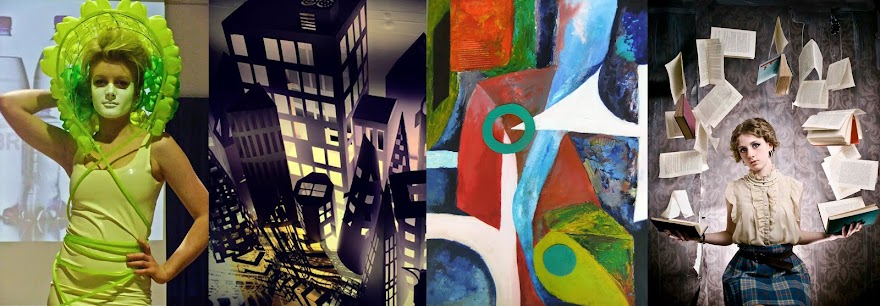
ART BTEC Header

ART BTEC Header

Monday, 11 March 2019

THINKING AHEAD...SPECIALIST AREAS

This month in tutor you should spend some time researching your options for specialising in the second year of the course,  and thinking about what course you might go onto when you leave.  This is an important decision and the more you can find out about the potential choices the better, here is a brief introduction to some of the main possibilities:

Specialist Areas

Fine Art

Fashion

Textiles

Three Dimensional Design

Graphics

Illustration

Animation

Film and Photography

Your task is to find out about the above and begin to make a shortlist of

5 Universities that you would be happy to go to and details of the courses you like. 

In making your choices consider your skills, content of the subject. location, cost and what you feel you would like to specialise in for 3 years.  (BA Hons).  

Look at the following and print out information for your Log book Folder ( something we will keep adding to for your units next year)

Go onto the following for information  and visit:

https://www.ucas.com/ - put a subject search in and a list of Univerisities will come up

Open days -   https://www.opendays.com/ - find out when the Open days are on a, go onto their website and book. Many are on now and open at the weekends.

Which University - https://university.which.co.uk/?gclid=CjwKCAiAiJPkBRAuEiwAEDXZZUo1goO1odf4NpdtK-yyiKfkYGrZ9_OcSUyZeBH-Pob9-2-o-1ISARoCYFgQAvD_BwE&gclsrc=aw.ds -  This allows you to see how others rate this course. 

UNIFROG -  Put a search in for Degree courses or Apprenticeships to see what is available in your specialist area.  

Each of the above areas is an umbrella term for a variety of sub-specialisations that can be found within these disciplines.


Fine Art

Fine Art course cover painting, sculpture, printmaking, photography and film.  Most courses are modular and follow a fairly diagnostic first year, where differing areas are experienced with the intentions of specialising within the second year.  There are still a few which require you to opt beforehand. 

If you intend to follow Fine Art you need to be very self motivated, have good drawing skills, and be a person that is interested in ideas.  All courses will expect you to have your own visual language and body of work that is more or less self motivated.  Don’t consider Fine Art if you thrive upon other people’s starting points.  Colleges will expect you to work unaided for a lot of the time.  Good Fine Art courses are competitive.  Some like Goldsmiths and Central St Martin’s like particular sorts of students.  Goldsmiths for instance prefer mature, highly intellectual, independent and conceptual workers.  If you like painting landscapes in a fairly traditional way don’t consider the above course.  Make sure you view the college to check your suitability.


Fashion

This field covers designing, making, technical and business aspects.  It essentially trains you to design a collection for industry, however it does have many spin off career paths such as a buyer and image consultant, and numerous fashion management positions.  You may become an in house designer where you work with a team of designers under a particular label such as Gucci or freelance designer who sets up their own label. 

Many courses cover pattern cutting, fashion drawing, all manner of fabric production and technique.  They deal with business management and preparing you for employment.  This can be a large or small part depending upon the College.  Some courses require you to learn a language and want Maths, Language and English GCSE as part of the entry requirements.

Fashion is competitive.  To work within it you need to be a person who keeps abreast of current design changes both contemporary and historical and who enjoys designing for the body.  You will need good like drawing skills, the ability to draw quickly and must be able to work under pressure with a range of differing personalities.


Textiles

This area covers a broad subject area which breaks down into numerous sub-headings.  There are a diverse range of courses such as those that specialise in print, knitwear and weave, surface.  To do textiles you need to love ‘change’ trends and keeping abreast of design and art styles.  You need to be good at working with colour and a range of materials but also need an excellent drawing base and be a versatile worker.  You need to love surface manipulation.

 To do this subject area you need to be a person who loves experimenting with colour, fabrics, texture and manipulation of colour. You may be producing sample designs, liaising with clients, interpreting clients ideas, assessing production standards,  be an in house-designer or working freelance.

Career pathways may be postgraduate study, buyer and merchandising, retail sales and markets, fashion journalist, management. etc there are courses that combine fashion and textiles and those that let you work diagnostically during the first year and then choose within the second to specialise.


Three Dimensional Design

This covers a wide range of design specialisations:

Furniture                       Theatre and Costume Design

Product Design             Ceramics

Jewellery                      Industrial

Interior                         Glass

Architecture                  Automotive

Craft

 This area is extremely far ranging and can only be mentioned in fairly general terms here.  In most courses students learn about the design process as well as studying design history.  Many courses have good links with industry although they vary considerably in what they offer and how courses are structured.  Some courses endorse working in expressive sculptural ways, others put more emphasis upon function and commercial usage.  Manufacturing Technology, ergonomics and material use are all areas that courses cover.  Look carefully at the costs of some courses as these may be expensive according to specialisms.  metals and jewellery, for instance, incur a fairly expensive sub. 

 To work within three dimensional design you need to have a good aptitude for constructing and perceiving in three dimensions.  You should have the ability to work with a variety of materials and be able to communicate your ideas well.  Good problem solving skills, accuracy and attention to detail area all desirable.  


Graphic Design

This is essentially coming up with ideas, big ideas which lead to ‘concepts’ and ultimately can head a campaign to advertise a product, event or idea.  It isn’t just about working with text and image and liking layout in fact this is a minor part of this discipline the important part of this subject area is ‘lateral thinking’ and the number of ideas that it is possible to generate.    Courses will cover branding and logos, animation, photography, typography, concept development.

You need to be a dynamic thinker, versatile worker and enjoy working to deadlines. You will also need a  knowledge of trends, fashion, and contemporary design. it is useful although not essential to have some skills within CAD.  Courses will train you when you arrive.  Some  Graphic courses will encourage links with industry or give you opportunities to enter competitions then it is a good sign.

Career pathways may be:

Web design

Advertising

Marketing

Video Gaming

Exhibition design

Magazine design

Film and video design


Illustration

Illustration is drawing with a purpose. This means it is a design field that always works to a brief.  Illustration isn’t just drawing and painting for children’s books.  It may cover this but also considers packaging, advertising, narrative, sequential, concept art, gaming design, information leaflets and editorial works.  Courses will tend to want good skills within drawing and painting and people that can explore and develop their own style.  Some courses will cover CAD and digital imaging.  You need to be a person that loves drawing,  can come up with loads of ideas and interpret others’ text or idea inventively.  You also need to be able to solve/ produce imagery to deadline. Illustration falls into 3 main headings:

Narrative – books, fiction, non fiction, magazines, lyrics,

Promotional- any product, event, person to be promoted from trainers - breakfast cereals - live music.

Informational – anything that passes on information to others about a place, cause, conditions, tourism to a guide to making cup-cakes.

Drawing skills need to be good; you need to willing to work to others’ starting points and ideas.  Related fields are animation and graphics.  You should expect to be able to work quickly. A few graphic and illustration courses are combined.  Look for more expressive courses if you want to broaden your approach.


Animation

Animation can be drawn, imaginative three dimensional models, storyboarding and film.  It covers cinematography, traditional and contemporary methods of working as well as the latest innovations in electronic animation.

To follow animation you need to have good drawing skills, an ability to think sequentially and to convert your thoughts to the camera.  It is a very specialised area which is very competitive.  To go into this field you need to have a strong interest and knowledge of contemporary animation.  Good storyboarding skills and preferably evidence within your folio that you have an aptitude to work within this industry.


Photography and Film

Courses within these areas vary enormously. Some are directed towards graphics, advertising or journalism and concentrate upon the commercial side.  Photography courses break down into the following:

Fashion and Advertising

Commercial Photography

Journalism and Editorial

Others are Fine Art based and are much more expressive.  Some courses combine practical skill with Art and Design history and professional practice.

You need a good eye for composition, experience of SLR cameras and darkroom processes and for film, and an ability to think sequentially.  An interest in photographers and film makers is a must and a flair for leadership and organisational skills is desirable.

Some courses have a mixture of the two areas, others are completely separate.  Most students choose one or the other as in themselves they are diverse areas.

Film courses are often based on television studies, media and film making.  Students are required to have excellent storyboarding skills, ability to think about time, soundtracks and sequential imaging.   You will learn about digital and technical working and be trained in the use of editing.  You will be expected to work in a team and lead others within the direction of your vision and ideas.  You need to be an excellent communicator.


PHOTOGRAPHY RESEARCH WEEK 2

In order to complement the photography you are doing you should look at a photographer whose work explores fantastical themes and makes extensive use of props, make up, costume and location. Annie Leibovitz's Alice in Wonderland or Peter Pan photos are a good example of this or work by Ruven Afanador or Viona Ielegems.   Give some brief biographical background, collect a range of good images then analyse the formal qualities of a couple of shoots.  Please produce 
  •  2 pages with imagery, background and some of your own analysis of a couple of specific shots, consider what practical steps went into creating the image we see. So discuss location, models, postures, costume, props, make up, composition, lighting, camera angle, post-production.
Glossery of terms to discuss when you are talking about this :


Photography and Film– Storyboarding, narrative, aesthetics, time and motion, sound, sequential imaging, photomontage, composition, formal elements, mindmapping, lateral thinking, use of  primary and secondary sources, effectiveness of communication, product, target audience, styling, costume, props, hair and make up, colour, models, intention, model gaze, symmetry, framing, movement, atmosphere, viewer's gaze etc etc

Annie Leibovitz

Ruven Afanador

Viona Ielegems

Monday, 4 March 2019

ILLUSTRATION INITIAL TASKS WEEK 1

Quentin Blake
  • Research into Quentin Blake's illustration (print out several examples of his work and include personal analysis of his technique, background information and at least one visual response).

Fantastic Mr. Fox, directed by Wes Anderson
    Research into at least 2 Films that are based on works by Roald Dahl. Again include vital information: director, year made, lead actors, some personal written response and good images from the film. It is particularly valuable to find "behind the scenes" information about the making of these films, for example storyboards and Artist's visualisations.
  • Photoshoot storyboarding for 3 scenes from your chosen Roald Dahl story with annotation. Carefully read some specific scenes from your chosen story, photocopy these sections (say 2/3 pages of text for each scene selected) and go through with a highlighter picking out key aspects to consider for your photoshoot (these could be descriptions of locations, characters, or action). Then use your analysis of the text to complete at least 3 pages of storyboards with annotation, also include breakdown of requirements for your shoot/s (models, location, props, make up, lighting etc.).
  • Examples of good existing storyboards presented in your sketchbook with some analysis (e.g. work by Josh Sheppard).
  • Making practical preparations for your shoot - gathering/making props, costume, planning make up, arranging use of locations, booking models, checking weather forecasts.
    You should be aiming to prepare for photoshoots either on location over the weekend or in the studio early next week. Book your studio times well in advance and get technical help from Photography staff and technicians (Amanda, Paul, Josh) to use the studio lights properly.

    ILLUSTRATION PROJECT ROALD DAHL

    BTEC Extended Diploma in Art and Design


    1st Year Project Brief
    “It’s Illustration Dahling!”

     ' Matilda'
    Specialism: Illustration
    This Project addresses the following Course Units:

    UNIT 38 – Mixed Media Image Making
    Target criteria
    P1
    Use experimental and non-traditional graphic media techniques and processes
    P2
    Use mixed media in producing graphic image outcomes
    P3
    Select reproduction techniques towards graphic image outcomes.
    M1
    Explore coherently, experimental and non-traditional graphic media
    M2
    Design an effective graphic media product which uses experimental and non-traditional graphic media practices
    M3
    Explain, with reference to well-chosen examples, reproduction techniques used towards graphic image outcomes.
    D1
    Explore independently, diverse experimental and non-traditional graphic media
    D2
    Design an innovative graphic media product independently, which uses experimental and non-traditional graphic media practices
    D3
    Evaluate, with reference to detailed examples, reproduction techniques used towards graphic image outcomes.
    UNIT 48 – Narrative Image Making
    Target criteria
    P1
    Investigate relevant examples of narrative imagery
    P2
    Review the processes used in illustrating narratives
    P3
    Develop ideas for narrative imagery in response to given themes
    P4
    Present narrative imagery
    M1
    Apply detailed investigations to inform narrative image making responses
    M2
    Analyse the processes used in illustrating narratives
    M3
    Develop coherent ideas for narrative imagery using effective visual language
    M4
    Concisely present resolved narrative imagery
    D1
    Integrate in-depth investigations and evaluation with development of innovative narrative image making responses
    D2
    Present diverse imaginative outcomes which demonstrate skilful narrative image making


    TIME: 7 Weeks
    ASSIGNMENT OUTLINE:
    In this project you will be responding to a piece of narrative text (selected from the works of Roald Dahl), initially through photography, which will give you the imagery to develop towards making illustrations in a range of media.
    The final objective is to produce a book of your illustrations. Your final images could depict a sequence of events or you may wish to select and portray several different scenes from the same book.

    WEEK ONE: Research and Storyboards
    In the first week of the project you will need to select and familiarise yourself with a book by Roald Dahl, many of you will know these stories well, but refreshing your memory through some reading will help you to visualise characters and scenes more effectively.
    A full list of Roald Dahl’s work can be found online at www.roalddahl.com but here are a few you may want to consider:

    Charlie and the Chocolate Factory, Fantastic Mr. Fox, George’s Marvellous Medicine, James and the Giant Peach, Matilda, The BFG, The Twits, The Witches, The Magic Finger, Revolting Rhymes, Tales of the Unexpected, Ryhyme Stew

    As soon as you have selected your text you need to start shortlisting scenes that interest you in terms of developing photographic and illustrational work. Choose at least 3 separate scenes. Now you need to deconstruct these scenes …what do they include in terms of characters? Props? Costume? Location? Make Up? (U48 P3, M1)
    You need to consider all these things carefully as you will be need to be resourceful and prepared in order to get as good a photoshoot as possible. To help you prepare for this you need to complete several pages of storyboarding for your shoot.

    Fantastic Mr. Fox Storyboard
     Use your storyboards to work out shot composition, use of props and location, camera angles and lighting. A good storyboard usually combines visuals with thoughtful annotation (U48, P3, M3). Find some good examples of these online and include them in your sketchbook with some analysis on why they work well (U48 P1, P2, M1, M2).
    Remember a storyboard should be a functional tool that helps you resolve potential problems and prepare effectively, if it also includes strong drawing and good layout that is a real bonus. You may also find making some lists of props, models, costume, make up and locations required is helpful to your planning. Think ahead, if you need to book studio time then do this in advance (use photography if possible, otherwise a small space exists within the Art department).
    This week you should also look at how others have interpreted the work of Roald Dahl, this will involve collecting imagery and analysing Quentin Blake’s original illustrations and films made by Tim Burton (Charlie and the Chocolate Factory) & Wes Anderson (Fantastic Mr. Fox). (U48 P1, M2)

    WEEK 2: Photography
    This week you need to carry out your photoshoot(s). Remember the imagery generated from this shoot will be sustaining your work for the next 5 weeks. If you get fantastic photos you are already a huge step down the road towards a successful project, poor or limited imagery will make the next 6 weeks a real struggle.
    Consider every aspect of your photos and be resourceful. If you have ambitious ideas about location shoots make every effort to carry them out, if you need time away from the college campus to do this, then this can be arranged, but staff must know of your plans in advance. (U48 P3)
    Use your storyboards for inspiration and direct your models to get the shots you need, don’t forget that dramatic lighting and camera angles can help create powerful imagery.
    Take lots of photos and print off contact sheets for your sketchbook. 

    Select your favourite 12 images to start your illustrations from and print these out at A5 or A4. You may need to tweak your selected images with Photoshop to ensure you have optimum colour, definition and contrast.
    Alongside your photography you need to research at least 2 photographers who explore narrative or fantastical themes through their work. Some good examples of this are Annie Leibovitz, Ruven Afanador, Viona Ielegems and Tim Walker (U48 P1).

    WEEK 3 and 4: Drawing
    Through weeks 3 and 4 we will be concentrating on making a range of good drawings from your photographic source imagery.  We want to see you explore drawing more thoroughly than you have done before: sustained studies, quick sketches and experimentation with a range of media, annotate and review your work as it progresses. (U48, P2, P3, M3, D1)
    Research 2 narrative Illustrators from different eras to support this work, compare the styles and discuss how techniques of illustration have evolved and altered. Produce some responses to your own photographs in the style of your selected illustrators.
    Suggested Historical Illustrators: Randolph Caldecott, Arthur Rackham, Harry Furniss, E.H. Shepard, Beatrix Potter, Sir John Tenniel.
    Suggested Contemporary Illustrators: Chris Haughton, Oliver Jeffers, Neil Gaiman, Dave McKean, Shaun Tan, Catherine Rayner. (U48, P1, P2, M1, M2, D1)

    WEEK 5 and 6: Printmaking and Mixed Media Experimentation
    Some time will be focussed on producing strong monoprints and relief (gold card) prints from your photos. We will then use the work you have generated to this point in the project to experiment with a mixed media approach. Use the photocopier, drawn elements, text, image transfer, photomontage, collage, printmaking, paint, acetates, photoshop etc. to come up with some inventive responses. (U48 D1) (U38 P1, P3, M1, D1)
    Research and analyse the work of at least 2 of the following illustrators to gain ideas for ways of applying a mixed media approach Eduardo Recife, Martin O’Neill, Tim Marrs, Dave McKean, Nazario Graziano, Mario Wagner, Eva Han, Tez Humphreys. (U38 M3, D3)

    WEEK 7: Selection, Presentation and Evaluation.
    In the final week of the project you will select, scan and save your best work from the preceding weeks then compose these images alongside original text from your story. You will need to make a small investment (approx. £15 - £25) at this stage to upload your images onto an online book provider (such as Snapfish, Mixbook, Shutterfly or Blurb) and order a hard copy. (U48 P4, M4, D2) (U38 P2, P3, M2, D2)
    You should complete your project with a word-processed evaluation of 600 – 800 words (further guidance for this will be given out). (U38 D3) (U48 D1)


    MINIMUM SUBMISSION REQUIREMENTS:
    A full detailed list will be given towards the conclusion of the project, but the following will all be required:
    ·         1 (or more) Sketchbooks with all the relevant research, storyboards, photography, drawing, printmaking and mixed media work.
    ·         A suitably bound book of your illustrations, alongside original text from Roald Dahl.
    ·         A word-processed Evaluation of 600-800 words.


    REFERENCES: See the project on Moodle where you can see the steps of this project.   Use the Course Blog for additional guidance http://btecartblog.blogspot.co.uk/  use the internet,look at you tube the making of  Fantastic Mr Fox  https://www.youtube.com/watch?v=CAo_qiGIfLw&index=2&list=PL1AEZsofRS5tXz-Xs2ZaLavsJPJNtuuM6 the library,  and of course your imagination!


    Thursday, 28 February 2019

    REFLECTIONS SPRING TERM

    PART 1. Reflecting on Progress: 

    When writing your reflections you should be considering the work we have completed since the last review – the Fashion and Architecture Projects.

    ·        In which of the two projects do you think you produced stronger work? Explain why you feel you were successful, look at the list of skills below and mention the areas in which you feel you performed well. 
    ·        Identify 2 aspects of your work/approach where you feel like a change would benefit your progress. Be honest and try to choose the things that will make the greatest impact on your future projects. 

    Some areas you might consider discussing in relation to the previous 2 points: 

    Self-Management Skills:
    ·        Attendance.
    ·        Preparation for lessons (making sure you have all the right equipment and are aware of what you will be doing and mentally prepared).
    ·        Focus in the studio and use of lesson times.
    ·        Enthusiasm and positivity about the work set.
    ·        Ability to complete private study at College (and at home).
    ·        Your time management skills (keeping up and meeting deadlines).
    ·        Avoiding distractions (phone/social media etc.), and using time productively.
    ·        Getting the balance right between College work and outside College commitments.

    Subject Specific Skills: 
    ·        Observational drawing. 
    ·        Research. 
    ·        Presenting and talking about your own work.
    ·        Willingness to experiment and take risks. 
    ·        Presentation of your sketchbooks. 
    ·        Ambition and sophistication of your outcomes. 
    ·        Use of IT, including subject specific software (e.g. PhotoShop). 

    Having thought about the strengths and weaknesses of your approach you should now identify at least 2 specific actions/targets that will help you to improve.

    For example:
    ·        “No unauthorized absences and arrive to all lessons on time”
    ·        “Cut down hours in part time job to allow more time for College work”
    ·        “Keep phone off in lessons and limit my time on social media to 2 hours a day”
    …or
    ·        “Take more care over my sketchbook layout, keep pages visually busy and consider title fonts carefully”
    ·        “Make the effort to analyse Artist’s work in my own words, commenting on technique, mood, line, colour in depth and explaining links to my own work”

    Talk about any new skills/techniques you have learnt in the last 2 projects.
    Are these skills that you are likely to use again?
    These might include: 

    ·        Creating and delivering a Presentation. 
    ·        Compiling Moodboards. 
    ·        Fashion Illustration. 
    ·        Garment construction techniques. 
    ·        Arranging a photoshoot. 
    ·        Mixed media collage. 
    ·        Paint transfer. 
    ·        Using PhotoShop.
    ·        Planning and completing an independent piece of work.

    
PART 2. Looking Ahead:

    Have you decided what area of Art and Design you want to specialise in next year?
    What draws you towards this area?
    If you are not clear on your direction next year mention areas you are considering and ones you know are not in the running. 
    Some of the main areas you should consider are: 

    • Fashion Design/Styling/Marketing 
    • Texile Design (Print/Constructed/Interior) 
    • Fine Art (Sculpture/Painting/Print/New Media) 
    • Illustration 
    • Animation 
    • Photography 
    • Graphic Design 
    • 3D Design (Product/Furniture/3D crafts etc.) 

    Thinking ahead explain what you think your next step will be after Alton College (e.g. University, Apprenticeship, Employment).
    Identify what practical actions you are taking/planning to help you towards your goals.

    For example:
    ·        “shortlist 5 University courses to visit and research when their open days are”.

    ·        “Book appointment with the College careers advisor and find out about employment and apprenticeship opportunities in creative areas”.